
By Donny Zanger, founder of BuildWrks, a lead-generation platform for contractors | Published November 28, 2026 | Updated November 28, 2026
General contractor cost in Los Angeles comes down to a fee of 10% to 20% of the construction cost in 2026. Large or complex jobs can reach 25%. On a $100,000 remodel, that is $10,000 to $20,000 on top of labor and materials. Design and permit fees often sit outside it.
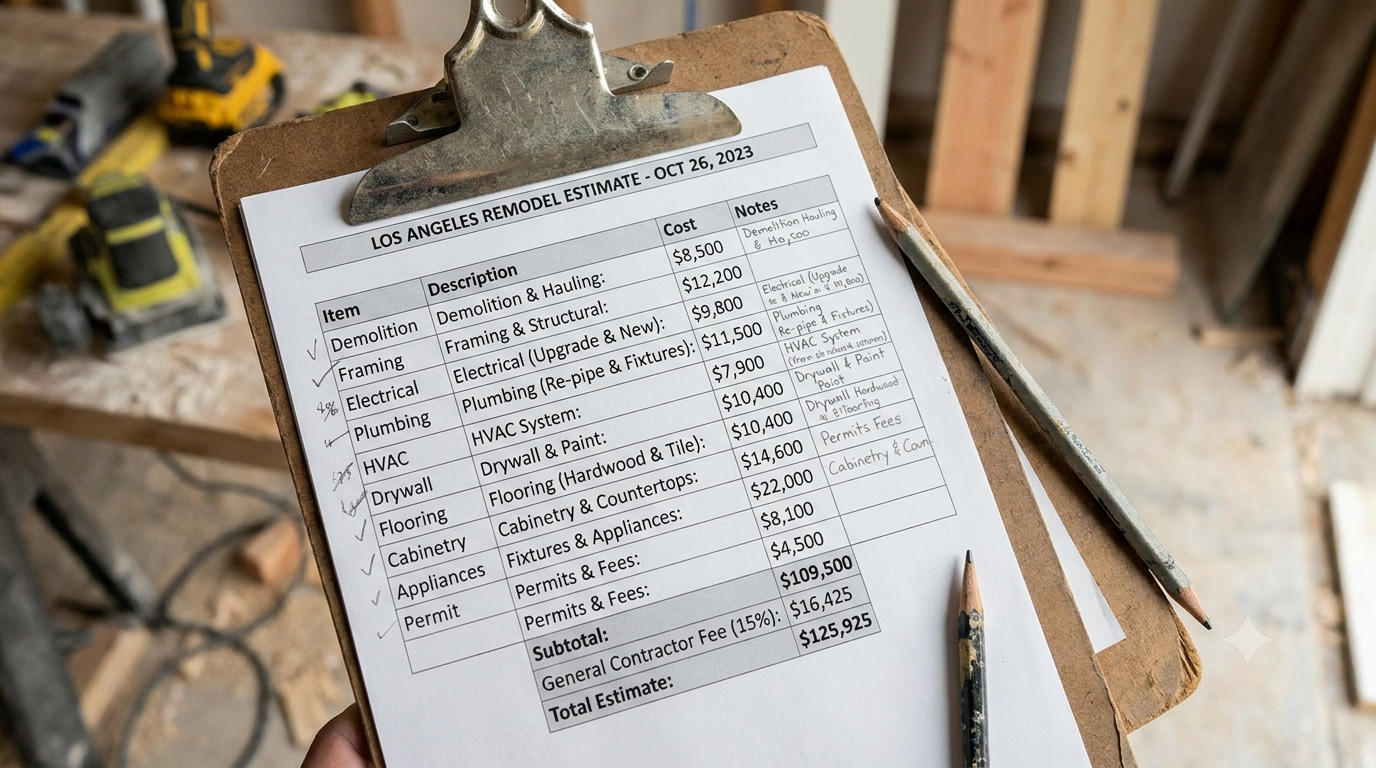
This guide shows how that fee works. You will see the math, the three ways contractors price a job, and what the fee covers. You will also see the California rules on deposits and licenses. Ready to compare bids? Start with our checklist for hiring a general contractor. Then use our guide to reading a contractor estimate on every bid you get.
How much does a general contractor cost in Los Angeles?
A general contractor in Los Angeles charges 10% to 20% of the construction cost as a fee in 2026. Large or complex jobs can reach 25%. On a $100,000 remodel, that is $10,000 to $20,000 on top of labor, materials, and subcontractor costs. The fee pays for the work a contractor does around the build. That includes scheduling and supervising subcontractors. It also includes pulling permits, booking inspections, and carrying insurance. Overhead and profit sit in the fee too. Some contractors quote one fixed price instead. Then the fee sits inside the total and never shows as a line item. Hourly billing is rare on remodels. Where it exists, national guides list $50 to $150 an hour. Design fees, engineering, and city permit fees often sit outside the contractor’s fee. Ask what each bid includes. Sources differ on the exact range. Treat every number here as a planning figure. Ask for a written, itemized bid.
What does the fee look like in dollars?
Here is the fee at four common percentages. Construction cost means the labor, materials, and subcontractor bills the contractor manages.
| Construction cost | Fee at 10% | Fee at 15% | Fee at 20% | Fee at 25% |
|---|---|---|---|---|
| $25,000 | $2,500 | $3,750 | $5,000 | $6,250 |
| $60,000 | $6,000 | $9,000 | $12,000 | $15,000 |
| $100,000 | $10,000 | $15,000 | $20,000 | $25,000 |
| $250,000 | $25,000 | $37,500 | $50,000 | $62,500 |
HomeGuide and Angi both put the fee at 10% to 20%. Angi says large projects can run closer to 25%. One Los Angeles builder’s 2026 guide lists 15% to 25% and cites no source for it. So 10% to 25% is the honest span. Where you land depends on job size, complexity, and how busy the contractor is.
Is the fee a markup or a share of the price?
Ask which one the contractor means. The two are not the same number. Say a contractor adds a 20% markup to $100,000 of costs. The price becomes $120,000. The fee is $20,000, which is 16.7% of that price. A “20% fee” can mean either one. Put the dollar amount in the contract and the question goes away.
A worked example: a mid-range kitchen
Say your kitchen needs $80,000 of cabinets, counters, appliances, trades, and permits. A contractor charging 15% adds $12,000. Your total is $92,000. That lands inside the $60,000 to $100,000 mid-range band in our kitchen remodel cost guide.
How do general contractors charge for a job?
Contractors use three pricing models. The model changes who carries the risk when costs rise.
| Model | How it works | Who carries cost risk | Best fit |
|---|---|---|---|
| Fixed price (lump sum) | One agreed price for a defined scope. The fee sits inside it. | The contractor, unless you change the scope | Clear plans and fixed selections |
| Cost-plus | You pay actual costs plus a fee, as a percentage or a set sum. | You | Unknowns behind walls, or a design still in flux |
| Time and materials | Labor billed by the hour or day. Materials billed on top. | You | Small repairs and open-ended fixes |
For most home remodels, fixed price gives you the clearest budget. Cost-plus makes sense when the job has real unknowns, like a 1930s kitchen with unseen wiring. If you choose cost-plus, ask for a cap and a receipt for every invoice. Whatever model you pick, California law requires a written contract for any home improvement job over $500 in labor and materials, per the Contractors State License Board (CSLB).
What does a general contractor’s fee cover?
The fee buys management and risk, not just a person at a desk. A good contractor earns it in five ways:
- Scheduling. Plumbers, electricians, and tile setters have to arrive in the right order. One missed slot can push the whole schedule back.
- Supervision. Someone checks the work before the next trade covers it.
- Permits and inspections. The contractor files the paperwork and meets the inspector.
- Insurance and licensing. The contractor carries the license, bond, and liability coverage that protect your home.
- Problem solving. Old homes hide surprises. Someone has to decide what to do when a wall opens up.
Here is what the fee leaves out:
- Design. One LA builder puts full design services at 8% to 15% of construction cost. Check the figure against your own designer’s quote.
- Engineering. Structural and soils reports are billed on their own.
- City permit fees. Some contractors pass these through at cost. Ask if they are in the bid.
- Owner-supplied items. If you buy the appliances, you manage the delivery.
- Surprises. A contingency fund is yours to set aside.
What do common Los Angeles projects cost in total?
The totals below come from our own cost guides. They already include the contractor’s fee. Each link shows the line items behind the range.
| Project | Typical LA total (2026) | Full guide |
|---|---|---|
| Kitchen remodel | $25,000–$150,000+ | Kitchen cost guide |
| Bathroom remodel | $8,000–$60,000 | Bathroom cost guide |
| Room addition | $80,000–$200,000 for most projects | Room addition cost guide |
| ADU (garage conversion) | $120,000–$240,000 | ADU cost guide |
| Flooring | $3–$25 per square foot installed | Flooring cost guide |
Want to talk through your numbers? Call +1 (424) 453-7821 and we will help you scope your project.
Why does a general contractor cost more in Los Angeles?
Four things push LA bids above the national figures.
- Rebuild demand. Home repair costs in Los Angeles rose 8.4% in 2025, the largest jump in California, according to Los Angeles Daily News research reported by The Real Deal. The report ties the rise to wildfire rebuilding, which strains labor, supplies, and permits.
- City permits. The Los Angeles Department of Building and Safety (LADBS) bases plan check and permit fees on project value. Bigger jobs pay more. Use the LADBS permitting page to find the fee calculator for your project.
- Older homes. Many houses in Highland Park, Mid-City, and Silver Lake date from the 1920s to the 1950s. Old panels and pipe add scope once walls open.
- Hillside and tight lots. Steep sites and narrow access raise labor time. Some need extra engineering.
Prices also move by city. Santa Monica, Pasadena, Glendale, and Burbank run their own permit offices, with their own fees.
How do payments work with a general contractor in California?
California sets firm limits. A home improvement down payment cannot exceed $1,000 or 10% of the contract price, whichever is less. After that, the contractor cannot ask for more than the value of the work done or the materials delivered. The CSLB contract page states the cap. It also says special-order materials get no exception.
So a request for a third of the price up front is a red flag. Tie each payment to a finished stage. Demolition done or cabinets set are good examples. Our guide to verifying a CSLB license shows how to check a contractor before you pay anything.
How do you compare general contractor bids?
Two bids can sit $30,000 apart and still describe different jobs. Use this checklist to put them side by side.
- Give each bidder the same written scope. Include the same drawings and the same fixture and finish list.
- Ask for line items. Labor, materials, permits, and the contractor’s fee should each show up.
- Check allowances. A low “allowance” for tile or fixtures means you will pay the gap later.
- Ask who pulls the permits. Make sure the fee for them is in the price or listed apart.
- Read the change-order terms. Find out how extra work gets priced and approved.
- Verify the license. Use the CSLB license check before you sign.
Set aside a contingency of 10% to 15% of the contract price for surprises. That is our planning advice, not a legal rule. In an older LA home, lean toward the high end.
Do you need a general contractor at all?
For small jobs, no. For most remodels, yes. California lets an unlicensed person take work up to $1,000 only if the job needs no permit and the person hires no workers, per a CSLB bulletin. Anything bigger needs a licensed contractor. Our guide to choosing between a general contractor and a handyman explains where the line falls.
You can hire each trade yourself and skip the fee. Then you become the project manager. You book the trades, pull the permits, and carry the risk when one trade damages another’s work. Weigh the fee against the time and risk you would take on.
Where General Contractor Los Angeles fits in
General Contractor Los Angeles is a referral network. We do not do the work ourselves. We send your project to an independent contractor in our network, and that contractor writes your estimate. Hold that estimate to every check in this guide. If a fee, line item, or permit plan is missing, ask for it before you sign.
Ready to price your project? See our home remodeling page, call +1 (424) 453-7821, or request a written quote below. You can also start from our homepage.
Frequently asked questions
What percentage does a general contractor charge in Los Angeles?
Most published guides put the fee at 10% to 20% of construction cost. Large or complex jobs can reach about 25%. Fixed-price bids hide the fee inside the total, so ask for a line-item breakdown.
Do general contractors charge for estimates?
Many do not charge for straightforward jobs. On large projects, a contractor can charge for a consultation and estimate, in some cases up to $1,000, according to Angi. Ask before you book a visit.
Can I negotiate a general contractor’s fee?
You can, but scope is a stronger lever than the percentage. Fix your selections before bidding, cut work you can do later, and compare itemized bids. A contractor who cuts the fee but pads the allowances has not saved you money.
Why are two Los Angeles bids so far apart?
The bids rarely describe the same job. Look for gaps in scope, allowances, permit duties, and cleanup. Put both on one written scope, then ask each contractor to re-price.
Is it cheaper to hire each trade myself?
You skip the contractor’s fee. You also take on scheduling, permits, and liability. Any job over $1,000, or any job that needs a permit, must go to a licensed contractor in California.
Does the fee change for a rebuild after a fire?
No law sets the fee, so the market does. Demand for crews helped push Los Angeles repair costs up 8.4% in 2025. Rebuild work also falls under the same CSLB payment rules. A deposit above $1,000 or 10% is not allowed.
For state rules, see the CSLB guide to home improvement contracts.
About the author
Donny Zanger is the founder of BuildWrks, a lead-generation platform for contractors.