
By Donny Zanger | Published October 4, 2026 | Updated October 4, 2026
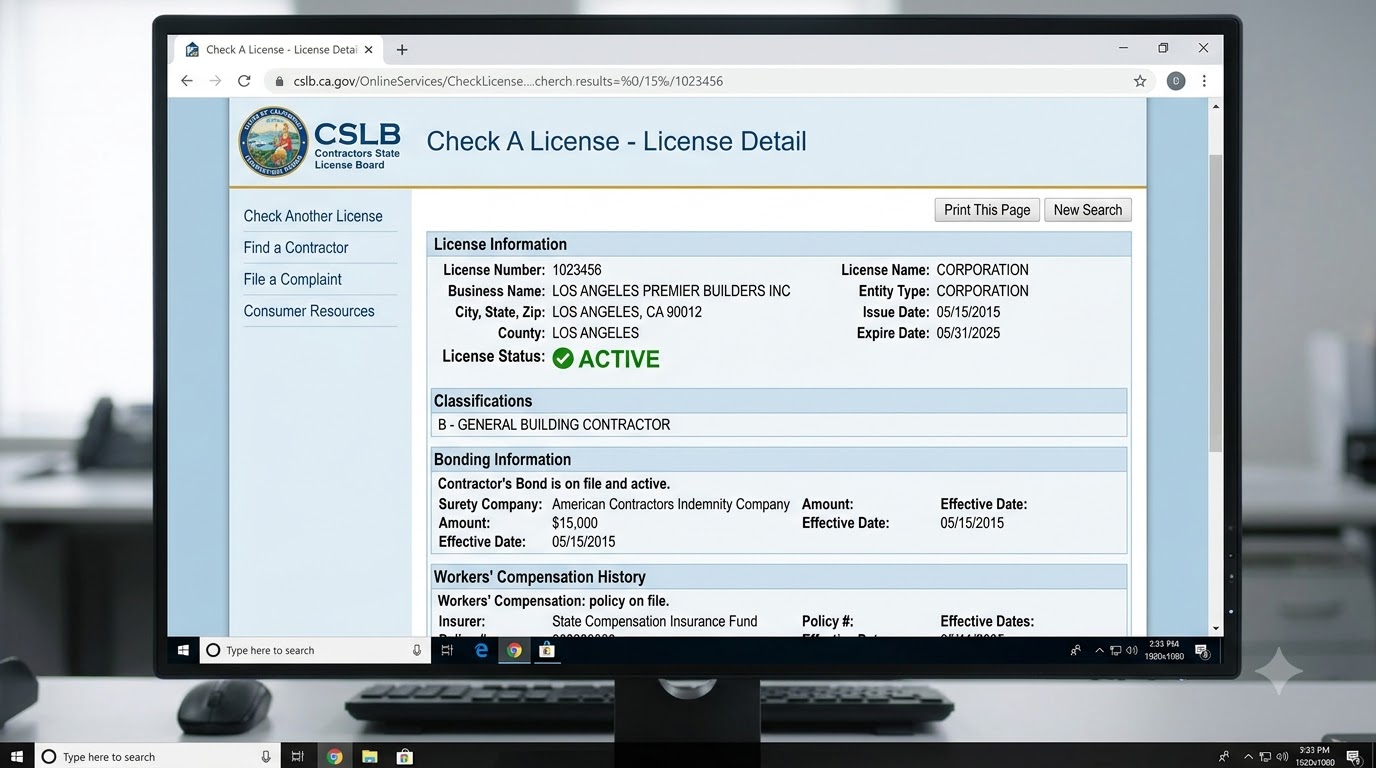
To check a licensed contractor in Los Angeles, ask for their license number. Then enter it in the free Check A License tool at cslb.ca.gov. Confirm four things. The status says Active. The license class fits your job. A $25,000 bond is on file. Workers’ comp is listed, or the contractor is exempt for a valid reason.
This guide walks through each check. It also covers the red flags that a license lookup won’t catch on its own.
Why does a CSLB license matter in Los Angeles?
California law says anyone who bids or takes on work worth $1,000 or more must hold a license from the Contractors State License Board (CSLB). That counts labor and materials together. The limit rose from $500 to $1,000 on January 1, 2025, under AB 2622.
A license is not a promise of good work. But it gives you real protection. A licensed contractor has passed a trade exam and a background check. They have posted a bond. And if the job goes wrong, you can file a complaint with a state agency that can act on it.
Hire someone without a license, and most of that protection is gone.
How do you verify a contractor’s CSLB license?
You can check any California contractor license online for free in a few minutes. Go to the CSLB website and open the Check A License tool. Search by license number for the most exact result. You can also search by business name or by a person’s name, but those return a list you have to sort through. Once you open the record, check the status first. It should say Active. Next, read the license class and make sure it covers your project. Then look for the bond. Every licensed contractor must post a $25,000 bond with CSLB. After that, check workers’ comp. The record shows either a policy or an exemption. Last, scroll down to the complaint disclosure section. It lists complaints CSLB referred for legal action, plus any citations or other actions. If any of these five checks fails, ask the contractor to explain before you sign.
No internet access? Call CSLB’s automated line at 800-321-2752 to check a license by phone.
What should each part of the license record show?
| Section | What you want to see | Red flag |
|---|---|---|
| Status | Active | Expired, suspended, revoked, or inactive |
| Business name | Matches the name on your bid and contract | A different name, or the number belongs to someone else |
| Classification | Fits your job (see below) | A single-trade license on a multi-trade remodel |
| Bond | $25,000 contractor bond on file | No bond listed, or a bond with a past end date |
| Workers’ comp | A current policy, or a valid exemption | Exempt, but a crew shows up to do the work |
| Complaints | None, or old issues that were resolved | Recent or repeated legal actions |
One check people skip is the name match. Scammers sometimes quote a real license number that belongs to a different business. If the name on the record doesn’t match the name on your contract, stop.
Which license class does your project need?
A license number alone is not enough. The class has to match the work. Here are the classes Los Angeles homeowners see most:
- B (General Building). Can take a job that needs two or more unrelated trades, like a kitchen remodel with framing, drywall, and tile. A B contractor can also take a framing or carpentry job on its own. But a B contractor can’t take a single-trade job, like plumbing alone, unless they hold that trade’s license too.
- B-2 (Residential Remodeling). Can take home remodels that need at least three unrelated trades. A B-2 contractor can’t change load-bearing walls, footings, foundations, or roof structures. Major electrical, plumbing, and mechanical work must go to a contractor with the right license.
- C classes (Specialty). These cover one trade. Examples are C-10 Electrical, C-36 Plumbing, and C-39 Roofing. Hire a C contractor when your job is mostly one trade.
So a room addition that moves a bearing wall needs a B license, not a B-2. CSLB lists every class in its licensing classifications guide.
How do you check workers’ comp and the bond?
The license record shows both. For workers’ comp, you will see a policy with an insurer name, or an exemption.
An exemption is legal for a contractor with no employees. But five classes must carry workers’ comp even with no employees: C-8 Concrete, C-20 HVAC, C-22 Asbestos Abatement, C-39 Roofing, and the tree service class (C-61/D-49). State law will also require it of all contractors starting in 2028.
Why does this matter to you? If an uninsured worker gets hurt on your property, you could be asked to pay. Your homeowner’s policy may have to cover it.
The $25,000 bond protects consumers. If a contractor breaks the law, damages your property, or fails to pay workers, you can file a claim against it. Keep in mind that $25,000 is the total. It may not cover a large loss, and other claims can draw on it first.
Have a project in mind? Call (424) 453-7821 to talk it through. Ask the contractor we match you with for their license number, and run the checks above before you sign.
Who else should have a CSLB record?
Sales reps need one too. Anyone who sells home improvement contracts for a licensed contractor must be registered as a Home Improvement Salesperson (HIS). That rule applies at any dollar amount. You can look up an HIS number in the same Check A License tool. The number ends in “SP.”
Also check any subcontractor who will do a large part of the work, like the electrician or roofer on a remodel. Their license class should match their trade.
What red flags won’t show up in a license lookup?
A clean record is a good start. These warning signs still matter:
- A big down payment. For most home improvement jobs, California caps the down payment at 10% of the price or $1,000, whichever is less.
- “You pull the permit.” If a contractor asks you to get the permit as an owner-builder, you take on the risk. You could be on the hook for unpaid suppliers and injured workers. A licensed contractor should pull permits through LADBS in their own name.
- A cash-only deal. This makes payments hard to trace if a dispute comes up later.
- Pressure to sign today. For most home improvement contracts, you have three days to cancel after signing. You have five days if you are 65 or older.
- No written contract. Get the scope, price, payment schedule, and start and finish dates in writing.
Our full checklist for hiring a general contractor in Los Angeles covers bids, contracts, and payment schedules in more detail.
A note on how General Contractor Los Angeles works
We are a referral network, not a contractor. When you send us a project, we match you with an independent contractor. That contractor gives you the quote and does the work.
That means the license you need to check is theirs. Ask the contractor for their CSLB number before you sign. Then run every check in this guide. If something on the record doesn’t match, tell us.
Frequently asked questions
Is a CSLB license check free?
Yes. The Check A License tool on cslb.ca.gov is free. You don’t need an account.
Do I need a licensed contractor for a small job in Los Angeles?
Not always. Under state law, work under $1,000 in labor and materials doesn’t need a license, as long as it needs no permit and the worker hires no one to help. Any job that needs a permit needs a licensed contractor.
What does “inactive” mean on a CSLB record?
The license exists, but the contractor can’t legally take on work right now. Don’t sign a contract until the status reads Active.
How long do I have to file a complaint with CSLB?
CSLB can act on a complaint about a project for up to four years. You can find the steps on CSLB’s complaint process page.
Does a CSLB license mean the contractor does good work?
No. It means they met the state’s basic rules. Check reviews, past projects, and written bids too.
Ready to start your project?
Once you know how to verify a licensed contractor, the next step is scoping the job. See what a kitchen remodel in Los Angeles or a bathroom remodel involves. Or call (424) 453-7821 to talk through your project.