
By Donny Zanger | Published October 17, 2026 | Updated October 17, 2026
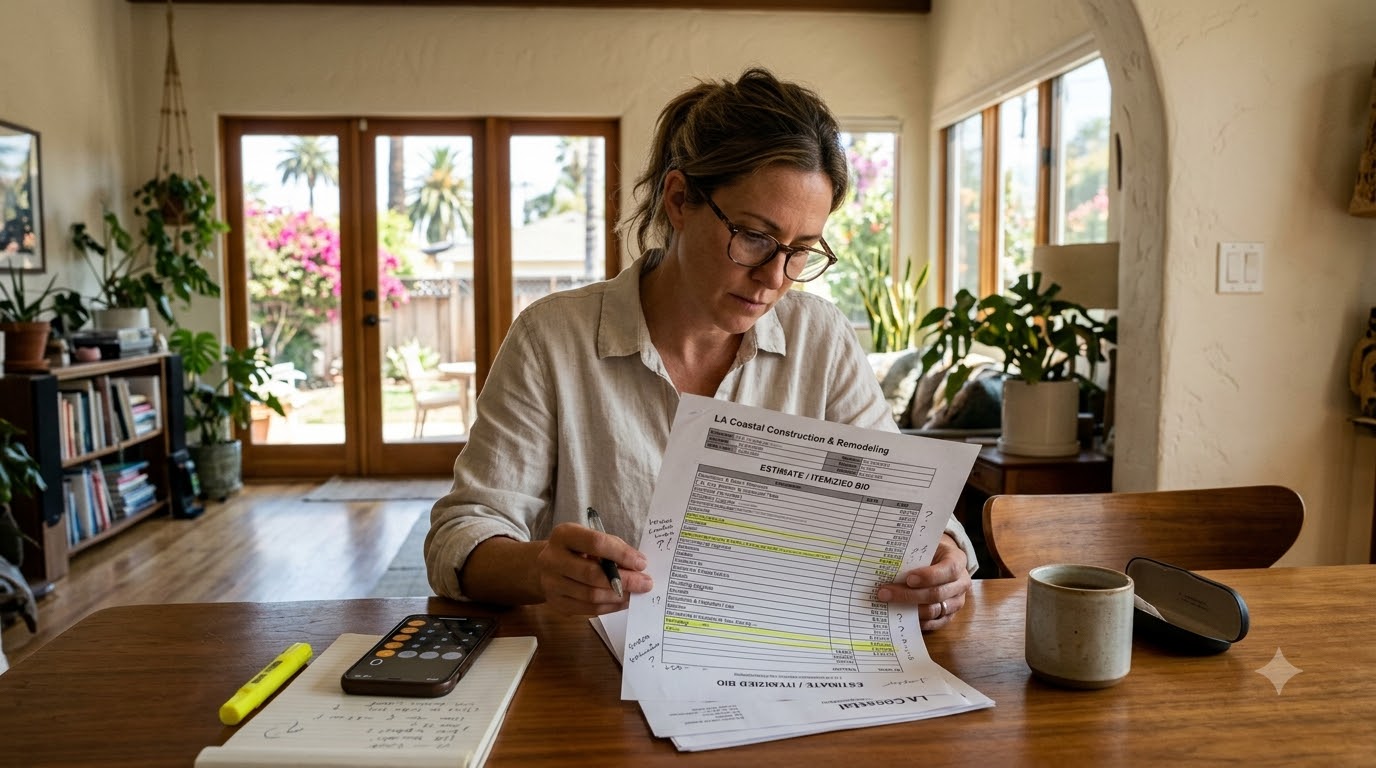
A good contractor estimate is written, itemized, and specific. It splits labor from materials. It names brands, sizes, and amounts. It says who pulls the permit. It ties each payment to finished work. The biggest red flag is a large deposit. In California, the down payment on a home improvement job can’t be more than $1,000 or 10% of the price, whichever is less.
So you’ve reached the point where you think, “I need a general contractor.” Next comes a stack of estimates. Some run one page. Others run ten. Some show a single number at the bottom. This guide shows you what each part of an estimate should say, which gaps should worry you, and how to compare two bids fairly. If you haven’t picked who to ask for bids yet, start with our full checklist for hiring a general contractor in Los Angeles.
What is the difference between an estimate, a bid, and a contract?
People use these words loosely. However, they mean different things, and the difference matters when money changes hands.
- Estimate: a contractor’s best guess at the cost. It can change once they look closer.
- Bid or quote: a firm offer to do a set scope of work for a set price.
- Contract: the signed agreement. This is the paper that binds both of you.
In California, any home improvement job over $500 needs a written contract. That figure covers labor and materials together. So the estimate is where the real deal starts to take shape. Whatever is vague in the estimate tends to stay vague in the contract.
What should a contractor estimate include?
A solid estimate answers six questions on paper: what work gets done, what it’s made of, who does it, when, for how much, and how you pay. The scope should describe each task in plain words, such as “remove and haul away existing tub” or “install new 20-amp circuit for the range.” Materials should be named down to brand, model, size, color, and quantity. Labor and materials should be priced on separate lines. The estimate should state who gets the building permit and whether permit fees are in the price. It should list a start date and an end date. It should show a payment schedule, where each payment matches a stage of finished work. It should also list what is not included, so nothing surprises you later. The California State License Board (CSLB) lists these same items as must-haves in a home improvement contract. If an estimate skips most of them, it can’t be turned into a fair contract without a lot more work.
Here is how those parts look line by line:
| Section | What a good estimate shows | What a weak one shows |
|---|---|---|
| Scope of work | Each task listed, room by room | “Remodel bathroom” |
| Materials | Brand, model, size, color, quantity | “Tile, mid-grade” |
| Labor | Priced on its own line, by trade or phase | Folded into one total |
| Allowances | Dollar amount per item, and what it buys | Not mentioned, or very low |
| Permits | Who pulls them, and whether fees are included | Silent |
| Demolition and cleanup | Haul-away and debris removal included | Silent |
| Timeline | Start date and finish date | “About a month” |
| Payments | Small deposit, then payments tied to finished stages | Half up front |
| Exclusions | A clear list of what is not covered | No list |
What are the red flags in a contractor estimate?
Any one of these is a reason to ask questions. Two or three together are a reason to walk away.
1. One price with no breakdown
A single number at the bottom tells you nothing. You can’t compare it to another bid. You also can’t tell what got left out. Ask for labor and materials on separate lines. A contractor who has priced the job carefully already has this breakdown.
2. Vague materials
“Install new flooring” could mean budget vinyl or solid oak. Without a brand and model, the contractor can swap in cheaper products and still say they kept their word. Ask for specifics on every major item.
3. Allowances that are too low
An allowance is a budget for items you haven’t picked yet, like tile or light fixtures. Low allowances make a bid look cheap. Then you pick real products, and the price climbs. Check each allowance against store prices for what you actually want.
4. A deposit over the legal limit
For home improvement jobs, California caps the down payment at $1,000 or 10% of the contract price, whichever is less. On a $40,000 kitchen, that means $1,000, not $4,000. There is no special exception for custom-order materials. The only exception is a contractor with a blanket performance and payment bond on file with CSLB. A request for half up front is a serious warning sign.
5. Payments that run ahead of the work
After the deposit, each payment should match work that is already done. State law says payments can’t go beyond the value of the work and materials delivered so far. A schedule that asks for money on set calendar dates, with no link to progress, puts you at risk.
6. No word on permits
If the estimate doesn’t say who pulls the permit, ask. Be careful with any contractor who says “you don’t need one” for a remodel. In the City of Los Angeles, the Department of Building and Safety (LADBS) requires a permit for most construction, alteration, and repair work. Unpermitted work can cause trouble when you sell or file an insurance claim.
7. No list of exclusions
Every estimate leaves something out. A good one says what. Common gaps include patching and painting after electrical work, hauling debris, and fixing damage found behind walls. If nothing is excluded on paper, you’ll learn the exclusions later, on the invoice.
8. A price that’s far below the others
If three bids come in close together and one is much lower, find out why. Often the low bid skipped part of the scope, used cheap allowances, or left out permits. Lay it next to the others line by line before you get excited.
9. Pressure to sign today
“This price is only good until tonight” is a sales tactic, not a pricing fact. CSLB warns about contractors who push for an instant decision or get annoyed when you ask for things in writing. A good contractor will give you time to read.
10. No license number on the paper
A California estimate or contract should show the contractor’s license number, address, and phone. Other states’ licenses don’t count here. Look the number up before you sign. Our guide on how to verify a CSLB license walks you through it in a few minutes. Also be wary of any contractor who asks for cash only.
Have an estimate in hand and not sure what you’re looking at? Call +1 (424) 453-7821 and we can walk through it with you.
How do you compare two contractor estimates side by side?
Comparing totals is the most common mistake. Two bids for “a kitchen remodel” may not cover the same kitchen. Instead, follow these steps:
- Use the same scope. Give each contractor the same written list of what you want done.
- Line up the allowances. If one bid allows $3,000 for tile and another allows $1,200, the totals aren’t comparable. Ask both to use the same figure.
- Match the exclusions. Note what each bid leaves out. Add a rough cost for those gaps.
- Check permits and cleanup. Confirm both include them, or both don’t.
- Compare payment terms. A slightly higher price with a fair schedule can carry less risk than a lower one that wants money early.
Once the scope matches, the price gap usually shrinks. Whatever gap is left is the real one.
What should you ask before you sign?
Bring these questions to the meeting. The answers should end up in writing.
- Who will do the work: your own crew, or subcontractors?
- Who pulls the permit, and are fees in this price?
- How do you handle a change in the plan? (Every change should be a written change order.)
- What happens if you find damage behind a wall?
- Do you carry workers’ comp and general liability insurance? Can I see the certificates?
- Will you give me lien releases as you pay your suppliers and subs?
- What warranty comes with the work, and is it in writing?
That lien question is easy to skip, but it matters. In California, a supplier or subcontractor who doesn’t get paid can put a lien on your home, even if you paid your contractor in full. Lien releases after each payment help protect you.
Why do older LA homes make estimates harder to trust?
Much of Los Angeles was built long before today’s codes. Think of a 1920s Craftsman in Highland Park, a Spanish-style home in Mid-City, or a 1950s ranch in the San Fernando Valley. Open a wall in a house like that, and you may find old wiring, galvanized pipes, or rot. None of that shows up in a walk-through.
For that reason, a fair estimate on an older home says how surprises get priced. Look for a line that explains how hidden conditions are handled. For example, work stops, the contractor shows you the problem, and you sign a change order before anything new gets built. A bid that ignores this risk isn’t cheaper. It just moves the cost to later.
Permits work the same way. LADBS covers the City of Los Angeles only. Santa Monica, Pasadena, Glendale, and Burbank run their own building departments, with their own fees and timelines. So check that the estimate names the right office for your address.
Where General Contractor Los Angeles fits in
General Contractor Los Angeles is a referral network. We don’t do the work ourselves. Instead, we send your project to an independent contractor in our network, and that contractor writes your estimate. Hold that estimate to every check on this page. If it arrives without line items, a payment schedule, or a permit plan, ask for them before you sign. You have every right to.
Ready to get an estimate for your project? Look at our kitchen remodeling or bathroom remodeling pages to see what each job involves. Or call +1 (424) 453-7821 to talk through your numbers.
Frequently asked questions
How much should I pay a contractor up front in California?
No more than $1,000 or 10% of the contract price, whichever is less. That is the legal cap for home improvement jobs. The only exception is a contractor with a blanket performance and payment bond on file with CSLB.
Should a contractor estimate be itemized?
Yes. An itemized estimate splits labor from materials and names the products. Without that, you can’t compare bids or hold the contractor to a standard. If you get one lump sum, ask for the breakdown.
Is a contractor estimate the same as a contract?
No. An estimate is a price guess. A contract is the signed deal. In California, any home improvement job over $500 needs a written contract, so don’t start work on an estimate alone.
Can a contractor charge more than the estimate?
Once you sign a contract, the price should only change through a written change order that you agree to. If a contractor raises the price without one, that is a warning sign. Before you sign, an estimate can still change.
How many estimates should I get?
Get at least two, and three if you can. More bids help you spot one that is far too low or leaves out part of the job. Just make sure every contractor bids on the same written scope.
For the full state rules, see the CSLB’s home improvement contracts guide and its guide to spotting contractor scams. For permits in the City of Los Angeles, see the LADBS permitting page.
About the author
Donny Zanger is the founder of BuildWrks, a lead-generation platform for contractors.