
By Donny Zanger | Published October 10, 2026 | Updated October 10, 2026
In California, the dollar amount decides. A handyman can legally take a job only if labor and materials together come to less than $1,000. The job also can’t need a permit, and the handyman can’t hire helpers. Past that line, you need a licensed contractor. This rule took effect on January 1, 2025.
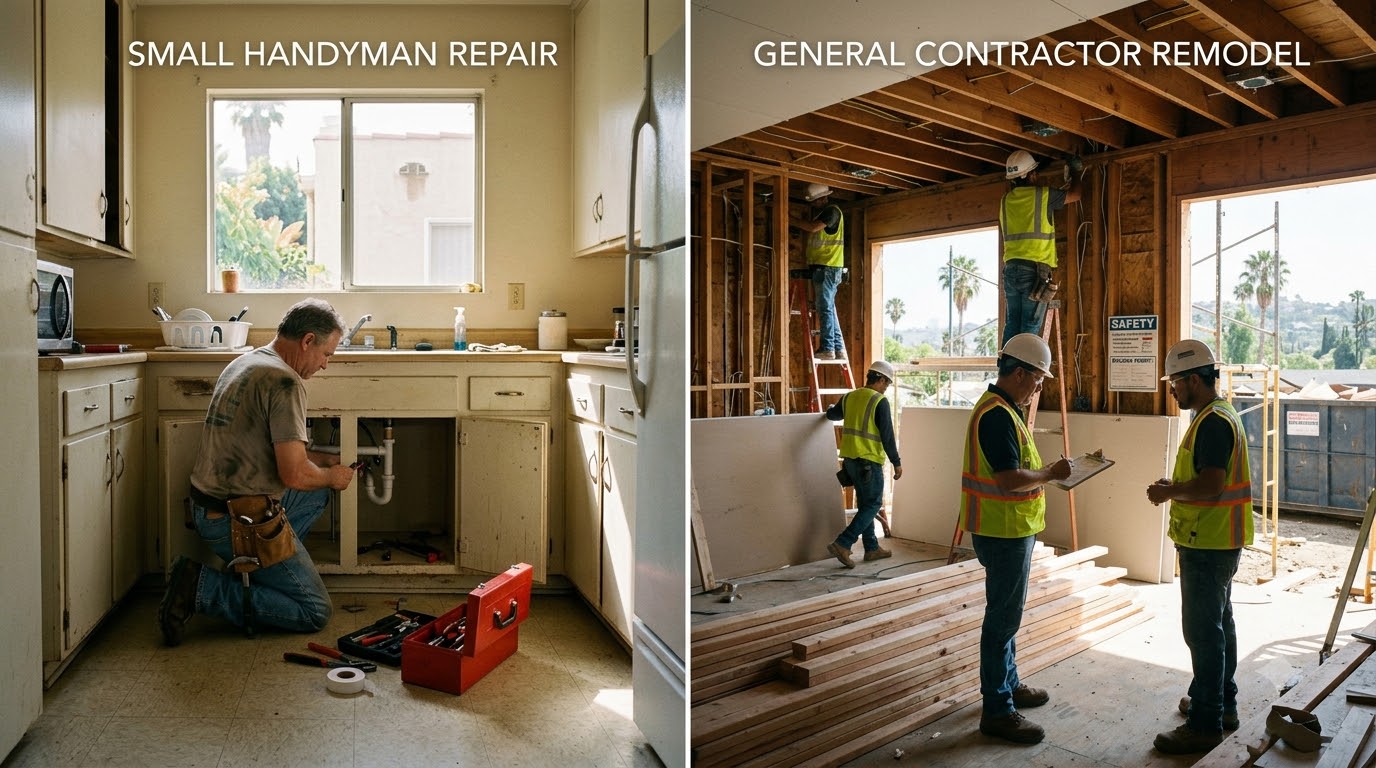
So the real question is not who is “better.” It is which side of that line your job falls on. This guide shows you how to tell. If you already know you need a general contractor for hire in Los Angeles, our full hiring checklist walks you through each step.
What is the difference between a general contractor and a handyman?
A general contractor runs a whole project. A handyman fixes small things.
The California State License Board (CSLB) issues the “B” license to general building contractors. A B contractor works on jobs that need at least two unrelated trades. Think of a kitchen remodel. It needs plumbing, electrical, drywall, cabinets, and tile. The general contractor plans that work, hires licensed trade pros for it, and keeps it on schedule. You can read the full rule on the CSLB’s B license page.
A handyman needs no state license. However, that freedom comes with tight limits. The job must be small, it can’t need a permit, and the handyman must do the work alone.
What is California’s $1,000 handyman rule?
Here is the short answer. California lets an unlicensed handyman take a job only when the total cost of labor and materials stays under $1,000. The job must not need a building permit of any kind. The handyman also can’t hire anyone to help, not even one worker. A handyman who advertises must say in the ad that they are not licensed. They also can’t claim to be a contractor. This limit used to be $500. A state law called AB 2622 raised it to $1,000, starting January 1, 2025. In addition, a job can’t count as “small” if it is one piece of a larger project that goes over the limit. If your job breaks any of these rules, the law treats it as contractor work. That means you need a person with an active CSLB license. The CSLB explains the change in its official AB 2622 bulletin.
Which jobs can a handyman do?
Good handyman jobs are small, quick, and need no permit. For example:
- Patching a small hole in drywall
- Hanging shelves, mirrors, or a TV mount
- Fixing a sticky door or a loose cabinet hinge
- Caulking a tub or a window
- Putting together furniture
Each of these must still pass the test. Is the total under $1,000? Does it need no permit? Will one person do it alone? If you can say yes to all three, a handyman is a fair choice.
When do you need a licensed general contractor?
You need a licensed contractor when any one of these is true:
- The job costs $1,000 or more, labor and materials combined.
- The job needs a building, electrical, plumbing, or mechanical permit.
- More than one person will do the work.
- The job is part of a bigger project that goes over $1,000.
That covers most remodels. A kitchen remodel, a bathroom remodel, or a whole-home renovation will land on the contractor side almost every time.
Not sure which side your project is on? Call +1 (424) 453-7821 and describe the job. We can tell you whether it needs a licensed pro.
Do you need a permit in Los Angeles?
Often, yes. In the City of Los Angeles, the Department of Building and Safety (LADBS) issues permits. Its rule is broad. LADBS says a permit is required for any construction, alteration, or repair work on private property in the city, aside from listed exemptions. You can check the details on the LADBS permitting page.
Keep in mind that LADBS covers the City of Los Angeles only. Cities like Santa Monica, Pasadena, Glendale, and Burbank run their own building departments. So call the office for your address before work starts.
This matters for the handyman question. Once a job needs a permit, the $1,000 rule no longer helps. Even a $400 job needs a licensed contractor if it needs a permit.
Why does this matter more in older LA homes?
Many Los Angeles homes are decades old. Think of a 1920s Spanish-style house in Los Feliz or a postwar ranch in the San Fernando Valley. In homes like these, a “small” fix can grow fast.
For example, say you hire someone to swap a light fixture. Then they open the ceiling and find old wiring. Now the job may need an electrical permit. Or a leak under the sink turns out to be a failing drain line behind the wall. At that point, the job has crossed into contractor work. A handyman must stop. A licensed contractor can keep going and pull the permit.
That’s why a quick look before you hire helps. Ask yourself whether the job could open a wall, a floor, or a ceiling. If it could, start with a licensed pro.
General contractor vs. handyman: side-by-side
| Question | Handyman | Licensed general contractor |
|---|---|---|
| State license needed? | No, for jobs under the $1,000 limit | Yes, from CSLB |
| Job size limit | Under $1,000, labor and materials combined | No dollar cap |
| Permit work? | Not allowed | Allowed, and they can pull the permit |
| Can hire helpers? | No | Yes, including licensed trade pros |
| Best for | Small, one-person repairs | Remodels, additions, multi-trade jobs |
| Max down payment | Not covered by the home improvement rules below | $1,000 or 10% of the price, whichever is less |
What should you check before you hire?
The checks depend on who you hire.
Before you hire a handyman
- Get a written price that includes both labor and materials.
- Confirm the total stays under $1,000.
- Ask whether the job needs a permit. If it does, stop.
- Ask whether anyone else will help. If so, they need a license.
Before you hire a general contractor
- Look up the license number on the CSLB site. Our guide on how to verify a CSLB license shows you how.
- Get a written contract with a clear payment schedule.
- Pay no more than $1,000 or 10% of the price up front, whichever is less. That is California’s legal limit on down payments for home improvement jobs.
- Tie each later payment to finished work. CSLB warns you not to pay ahead of the work done. See its payment rules sheet.
How General Contractor Los Angeles fits in
General Contractor Los Angeles is a referral network. We do not do the work ourselves. Instead, we send your project to an independent contractor in our network. That makes us a fit for contractor-sized jobs, such as remodels, flooring, or painting projects. For a single loose hinge, a handyman is likely the better call.
If your job is on the contractor side of the line, the next step is simple. Call +1 (424) 453-7821 to talk through it, or request a written quote below.
Frequently asked questions
Can a handyman do electrical or plumbing work in California?
Only if the job needs no permit and stays under $1,000. Most electrical and plumbing work that goes past a simple swap needs a permit. Once a permit is needed, you need a licensed contractor, no matter the price.
Can I split a big job into small jobs to hire a handyman?
No. A job doesn’t count as minor if it is part of a larger project that goes over $1,000. Splitting one project into small bills does not make it legal.
Is the handyman limit still $500?
No. The limit rose from $500 to $1,000 on January 1, 2025, under AB 2622. Older articles online may still say $500.
How do I check a contractor’s license?
Ask for the license number. Then enter it in the free Check A License tool on the CSLB website. Confirm the license is active and the class fits your job.
Is a general contractor more expensive than a handyman?
For the same small task, often yes. But that’s the wrong comparison. A general contractor handles jobs a handyman can’t legally take. So for permit work or jobs over $1,000, the choice is between a licensed contractor and an illegal hire.
About the author
Donny Zanger is the founder of BuildWrks, a lead-generation platform for contractors.